A plumber and homeowner discussing repair options on a tablet beside a kitchen sink.

5 Questions to Ask Before a Plumbing Repair

Most of us don’t spend much time thinking about plumbing repairs until we need one. Then, all at once, we’re trying to understand what’s wrong, what it will cost, and whether we’re making the right decision.

It’s a lot to sort out while you’re also trying to get through a normal day.

At Buddy the Plumber, we want Chattanooga-area homeowners to feel comfortable asking questions. You live with the plumbing every day, and you’re the one deciding what work gets done. You deserve an explanation that makes sense.

Here are five questions worth keeping handy the next time you need a plumbing repair.

1. What’s causing the problem?

Start here. Before talking about parts or prices, ask the plumber to explain what they found and how it relates to what you’ve been noticing.

A helpful way to ask is, “Can you show me what’s wrong and explain why it’s happening?”

Sometimes the cause is visible. Other times, it takes more investigation. If the plumber hasn’t confirmed the cause yet, ask what the next step will be and whether that diagnostic work has a separate charge.

Share what you know, too. When did the problem start? Does it happen every time you use the fixture, or only occasionally? Has someone worked on it before? Those details give the plumber a better starting point.

2. Can this be repaired, or does replacement make more sense?

Homeowners often assume a broken fixture means buying a new one. Sometimes a repair is a reasonable option. Sometimes the condition of the fixture makes replacement worth considering.

Ask what each available option would actually accomplish.

For example, would the repair address the current problem while leaving other worn components in place? Would replacement require changes to the existing connections? Are compatible repair parts available?

You can also explain your priorities. Maybe you’re happy with the fixture and would prefer to keep it. Maybe you’ve had repeated trouble and want to understand the replacement options. Either way, that conversation belongs in the decision.

3. What’s included in the price?

A number is easier to understand when you know the work behind it.

Ask for a written description of the proposed repair and clarify what the quoted price covers. Depending on the job, useful questions include:

  • Does this include parts and labor?
  • Is the diagnostic or service-call charge included or separate?
  • Does the price include removing and disposing of the old fixture?
  • If access requires opening a wall, who handles putting it back?
  • How will additional work be discussed and approved if something unexpected turns up?

These questions help everyone start with the same expectations. They’re especially useful when you’re comparing estimates, because two prices may cover different work.

4. How will the repair affect my day?

This is the practical question that’s easy to forget.

Will the water need to be shut off? Will you be able to use another bathroom? Does the plumber need access to a cabinet, garage, or another part of the house? Is the work expected to be completed during this visit, or could it require a return trip?

You don’t need an exact minute-by-minute schedule. An approximate plan helps you work around school pickups, meetings, pets, and everything else happening at home.

Tell the plumber about any access issues or scheduling limits early. It’s much easier to plan around them before the work starts.

5. What should I know after the work is finished?

Before the visit wraps up, ask the plumber to walk you through what was done and anything you should know about using the repaired or replaced fixture.

Find out whether any care instructions apply, what to watch for, and whom to contact if you have a question afterward. Ask what warranty, if any, applies to the parts and the labor, and get the terms in writing. Coverage can vary by product and job.

Keep the invoice and any product information somewhere you can find them. Having a record of the work makes future conversations easier, whether you’re calling about the same fixture or planning another project.

You Don’t Need to Know the Plumbing Terms

You don’t have to ask these questions perfectly. “Can you explain that another way?” is a perfectly good question, too.

Our goal at Buddy the Plumber is to help you understand the problem and the proposed work so you can make a decision you’re comfortable with.

If you’d like to get to know the person behind that approach, meet Jayce Anderson, our partner and master plumber.

Common Questions About Plumbing Repairs in Chattanooga

Can a plumber give me an accurate repair price over the phone?

A phone conversation can help explain the concern, but a firm repair price may require an on-site inspection. Access, the condition of the plumbing, and the parts needed can affect the scope of work. When you call, ask whether there is a service-call or diagnostic fee and when you will receive the repair price.

What information should I have ready when I call a plumber?

Have your address, the location of the problem, and a short description of what is happening ready. Mention when it started, whether it is getting worse, and any previous repairs. Photos or a short video may help explain a problem that comes and goes. You do not need to know the name of the broken part.

How do I compare two plumbing repair estimates?

Compare the written scope of work as well as the price. Check whether both estimates include the same parts, labor, diagnostic charges, disposal, and any restoration work. Ask about exclusions and warranty terms. If one estimate recommends a repair and another recommends replacement, ask each plumber to explain the reason.

Should I buy a replacement faucet or toilet before calling?

It is worth checking compatibility and installation requirements with your plumber before buying. A fixture’s dimensions, connections, and required clearances can affect whether it will work in your space. If you already have a product in mind, share its model number and ask about installation costs and how customer-supplied parts affect warranty coverage.

How do I schedule a plumbing repair with Buddy the Plumber?

Call Buddy the Plumber at 423-401-9009 or request service online. Share your plumbing concern and your location so the team can confirm service availability and scheduling. Buddy serves Chattanooga and nearby Tennessee communities.

Have a Plumbing Question? Call Buddy.

Buddy the Plumber is locally owned and serves Chattanooga and nearby Tennessee communities, including Hixson, Red Bank, East Ridge, Ooltewah, Harrison, Signal Mountain, and Soddy-Daisy.

Whether you’re ready to schedule a repair or want to talk through a plumbing concern, give us a call.

Call 423-401-9009 or request service online.

It helps to have a Buddy you can ask.

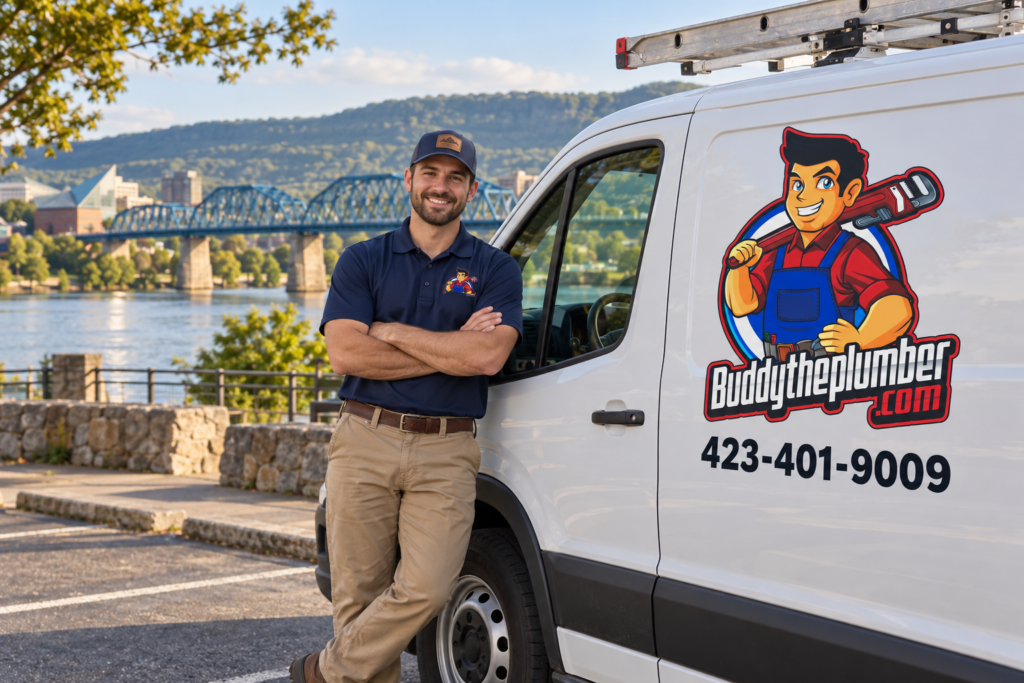
Illustration of a plumber beside a white Buddy the Plumber van overlooking Chattanooga’s riverfront and Walnut Street Bridge.

Buddy the Plumber: A Local Plumbing Company That’s Growing Right Here in Chattanooga

There’s something different about calling a local company.

You’re not calling a giant corporation somewhere across the country. You’re calling people who live here, work here, drive the same roads you do, and are building a business right here in the Chattanooga area.

That’s Buddy the Plumber.

We’re a locally owned plumbing company, and we’re growing. But as we grow, there’s one thing we don’t want to lose — the feeling that when you call Buddy, you’re calling somebody you can actually count on.

Because plumbing problems are stressful enough already.

If It’s Plumbing, There’s a Good Chance Buddy Can Help

Sometimes it’s obvious you need a plumber.

You wake up and there’s no hot water.

The toilet won’t stop running.

The kitchen sink is backed up.

There’s water somewhere that definitely shouldn’t have water.

Other times, it’s something small that you’ve been putting off for the last three months because it hasn’t gotten bad enough to deal with yet.

We understand that too.

Buddy the Plumber handles the everyday plumbing problems Chattanooga-area homeowners deal with, as well as the bigger problems that need attention quickly.

That includes drain cleaning, water heater repair and replacement, tankless water heaters, leaking pipes, faucets, toilets, sinks, garbage disposals, plumbing fixtures, plumbing inspections, and general plumbing repairs.

And if you’re not exactly sure what’s wrong?

That’s okay.

You don’t have to diagnose it before you call us. That’s our job.

Clogged Drain? Let’s Get It Moving Again.

Everybody has dealt with a slow drain at some point.

At first, the water takes an extra few seconds to disappear. Then it takes a minute. Then one day you realize you’re standing in water while taking a shower.

A slow drain is usually trying to tell you something.

Buddy provides professional drain cleaning for clogged and slow-moving sinks, tubs, showers, toilets, and drain lines.

Instead of fighting with it every few weeks, let’s figure out what’s causing the problem.

No Hot Water Is a Terrible Way to Start the Day

You usually don’t think much about your water heater.

Until it quits.

Then suddenly it becomes the most important appliance in the house.

Buddy the Plumber provides water heater repair, replacement, and installation throughout the Chattanooga area.

We also service tankless water heaters, including maintenance and flushing.

If your water isn’t getting hot enough, you’re running out of hot water faster than you used to, you hear strange noises from the tank, or you notice water around the water heater, give us a call.

We can take a look and help you determine whether repairing it or replacing it makes the most sense.

And Then There Are Those Little Plumbing Problems…

The faucet that drips all night.

The toilet you have to jiggle.

The garbage disposal that hums but doesn’t actually dispose of anything.

The sink that leaks just enough to keep everything underneath it damp.

The mysterious water spot that you keep hoping will disappear.

Those little problems have a habit of becoming bigger problems.

Buddy can help with leak detection, faucet and fixture repair, toilet repair and replacement, garbage disposals, sinks, pipes, connections, and other general plumbing repairs.

Sometimes the best plumbing repair is simply taking care of something before it becomes an emergency.

Chattanooga Is Home

We’re proud to be a Chattanooga-area company.

Buddy the Plumber serves homeowners and businesses throughout Chattanooga, East Ridge, Red Bank, Hixson, Ooltewah, Collegedale, Harrison, Signal Mountain, Lookout Mountain, Soddy-Daisy, Apison, Ringgold, Fort Oglethorpe, Rossville, Chickamauga, and surrounding communities.

If you’re close by and don’t see your town listed, call us anyway.

There’s a pretty good chance Buddy can come see you.

We’re Growing — And We Think That’s a Good Thing

We’re proud that Buddy the Plumber is growing.

But we also know something important:

Growth only matters if people are happy they called you.

We want to build Buddy the Plumber into a company Chattanooga homeowners recognize and trust. That doesn’t happen because of a fancy truck, a catchy name, or an advertisement.

It happens one customer at a time.

One plumbing problem solved.

One phone call handled the right way.

One homeowner who feels comfortable recommending Buddy to a neighbor, friend, or family member.

That’s the kind of plumbing company we’re working to build.

You Don’t Have to Know What’s Wrong Before You Call

This might be the most important thing we can tell you.

You don’t need to know plumbing.

You don’t need to know what part is broken.

And you definitely don’t need to spend two hours searching the internet trying to diagnose it yourself.

Just tell us what you’re seeing, hearing, smelling, or experiencing.

We’ll take it from there.

Whether it’s a clogged drain, a leaking pipe, a broken water heater, a toilet that won’t cooperate, or simply something that doesn’t seem right, call Buddy.

Because when something goes wrong with your plumbing, it helps to have a Buddy who knows plumbing.

Buddy the Plumber
Locally owned. Proudly serving Chattanooga and the surrounding communities.

423-401-9009

The Master Plumber Behind Buddy the Plumber

Meet Jayce Anderson: The Master Plumber Behind Buddy the Plumber

Hey there — I’m Jayce Anderson, partner and master plumber here at Buddy the Plumber. If you’ve ever had a plumbing problem and felt that little knot in your stomach wondering who to call, who’s going to show up, and whether they’re going to shoot straight with you — I get it. That feeling is exactly why I do this the way I do. So before you ever pick up the phone, I figured I’d introduce myself and tell you what you can expect when a Buddy the Plumber truck pulls into your driveway here in Chattanooga.

How I Got Into This Trade

I didn’t fall into plumbing by accident. I came up in it — the long way, the right way. Plenty of people can turn a wrench, but earning a master plumber license in Tennessee takes years of apprenticeship, real jobs in real homes, and a lot of hard-earned knowledge you only get by seeing what actually goes wrong inside people’s walls and under their floors.

A master plumber isn’t just a title on a business card. It means I’ve been tested on the code, on the craft, and on the judgment calls that separate a repair that lasts from one that comes back to bite you in six months. When something’s behind a wall and you can’t see it, judgment is everything. That’s the part you’re really paying for.

Over the years I’ve worked on just about everything Hamilton County can throw at a plumber — burst pipes at midnight, water heaters that quit on a holiday, sewer lines in older homes that were never meant to last this long, and hard-water buildup that quietly wrecks a house one fixture at a time. There’s not much I haven’t seen. And every one of those jobs taught me something I carry into the next one.

Why I Partnered With Buddy the Plumber

I’ve worked for outfits that treated plumbing like a numbers game — get in, upsell, get out, move to the next ticket. That never sat right with me. I wanted to be part of a company that treats the person on the other side of the door like a neighbor, not a lead.

That’s what drew me to Buddy the Plumber. We’re a local Chattanooga company, and we act like it. When I show up at your house, I’m not thinking about a quota. I’m thinking about fixing your problem correctly, explaining what I’m doing in plain English, and leaving you glad you called. Because in a town like this, your reputation is your business. Word gets around. I want it to get around for the right reasons.

What You Can Expect When I Show Up

Here’s my promise to you, and it’s the same promise every one of our technicians makes:

I’ll tell you the truth. If it’s a cheap fix, I’ll tell you it’s a cheap fix. If you’ve got a bigger problem brewing, I’ll show you why — and I won’t pressure you into anything you don’t need. You’ll get the honest version, even when the honest version costs me the bigger sale.

I’ll explain it so it makes sense. Plumbing gets treated like a mystery, and that’s usually on purpose. Not with me. I’ll walk you through what’s wrong, what your options are, and what I’d do if it were my own house.

I’ll respect your home. I treat your house like my own — clean up after myself, watch where I step, and leave the place the way I found it, minus the problem.

I’ll price it upfront. You’ll know the cost before I start turning wrenches. No surprises on the invoice, no “well, it turned out to be more” after the fact.

I’ll do it right the first time. This is the big one. A repair that has to be redone isn’t a repair — it’s a headache with a bill attached. My name is on this work, and I want it done once, done right, and done to last.

The Kind of Work We Do

Whether it’s a small annoyance or a full-blown emergency, our team handles the whole range of residential plumbing for Chattanooga homeowners:

  • Leak detection and pipe repair
  • Water heater repair, replacement, and tankless upgrades
  • Drain cleaning and sewer line work
  • Toilet, faucet, and fixture repair
  • Water filtration and softening for our hard-water homes
  • 24/7 emergency plumbing when it can’t wait until morning

Different jobs, same standard. Fix it right, fix it fast, and treat you fair while we do it.

We’re Local — And We Plan to Stay That Way

Buddy the Plumber serves Chattanooga and the communities around it — Hixson, Ooltewah, Soddy Daisy, Harrison, Red Bank, Signal Mountain, Lookout Mountain, and Lookout Valley. These aren’t just service areas on a map to me. They’re the neighborhoods where our customers live, where they raise their families, and where they’ll tell their friends whether or not we’re worth calling.

That’s a responsibility I take seriously. Every job is a chance to earn a customer for life, not just close a ticket.

Let’s Fix It Together

So that’s me — Jayce Anderson, your master plumber at Buddy the Plumber. When something goes sideways with your plumbing, I hope you’ll think of us. You’ll get honest work, straight answers, and a job done right the first time. That’s the whole deal, and I don’t complicate it.

Got a plumbing problem, or just want a plumber you can count on before you need one? I’d love to earn your trust.

Ready When You Are

Give us a call and let’s get it handled — the right way.

📞 423-401-9009 | Request a Quote

Serving Chattanooga · Hixson · Ooltewah · Soddy Daisy · Harrison · Red Bank · Signal Mountain · Lookout Mountain · Lookout Valley, TN

Why Your Garbage Disposal Keeps Jamming?

Why Your Garbage Disposal Keeps Jamming (And What Chattanooga Homeowners Should Never Put Down It)

Your garbage disposal is the one appliance in your kitchen that gets used hard, gets zero maintenance, and gets blamed the moment the sink backs up. Here in Chattanooga, disposal calls spike right after holidays and big family dinners — and almost every one of them traces back to something that went down the drain that shouldn’t have.

Here’s what’s actually going on, and how to tell the difference between a two-minute fix and a call to Buddy the Plumber.

The Sounds Your Disposal Makes — and What They Mean

It hums but doesn’t spin. The motor is getting power, but the flywheel is jammed. Something is wedged between the impellers and the grind ring. Do not keep flipping the switch — you’ll burn out the motor and turn a jam into a replacement.

It clicks, then nothing. The unit tripped its internal overload protector. There’s a small red reset button on the bottom of the disposal. Press it and try again — but if it trips repeatedly, something is binding.

It rattles or grinds loudly. Usually a foreign object — a spoon, a bottle cap, a bit of glass. Sometimes it’s a worn impeller.

It’s completely silent. Either the switch, the outlet, or the motor has failed. If the reset button doesn’t bring it back, the unit is likely done.

What Should Never Go Down a Garbage Disposal

This is the part that saves you a service call. Disposals grind — they don’t dissolve. These are the repeat offenders we pull out of Chattanooga kitchen drains:

  • Grease, oil, and bacon fat. It goes down warm and liquid, then cools and hardens in the line just past the disposal. This is the single most common cause of kitchen drain backups.
  • Coffee grounds. They don’t break down. They pack together into a dense sludge in the trap.
  • Eggshells. The membrane wraps around the impellers, and the shell grit builds up like sand in the trap.
  • Fibrous vegetables — celery, corn husks, artichoke, onion skins. The strings wrap around the flywheel and stop it cold.
  • Starchy foods — pasta, rice, potato peels. They swell with water and turn to paste.
  • Bones and fruit pits. Disposals aren’t built for them.
  • Anything non-food. Twist ties, produce stickers, rubber bands, silverware.

The short version: a disposal is for the scraps that rinse off a plate, not for the contents of a mixing bowl. Scrape the plate into the trash first, then rinse.

The Real Reason Disposals Cause Backups in Older Homes

A working disposal doesn’t guarantee a working drain. What it does is chop food fine enough to go past the disposal — and straight into a drain line that may not be up to the job.

In older homes across Chattanooga, Red Bank, and Hixson with aging drain lines, those interior pipe walls are rough. Ground food particles and grease cling to them, layer after layer. The disposal is working fine. The pipe downstream is what’s failing.

This is why “the disposal runs but the sink still won’t drain” is such a common call. The appliance isn’t the problem — the line is.

Fixes You Can Do Yourself (Safely)

Before you touch anything: kill the power. Unplug the unit under the sink, or shut off the breaker. Never put your hand in a disposal, and never trust the wall switch alone.

To clear a jam: Most disposals come with a hex wrench that fits a socket on the bottom of the unit. Work it back and forth to free the flywheel. If you don’t have the wrench, a wooden spoon handle inserted from the top can rock the impellers loose. Then hit the reset button.

To fight odor: Ice cubes and citrus peels help scour the grind chamber and cut the smell. This is maintenance, not a fix — persistent odor usually means buildup in the trap.

What not to do: Don’t pour chemical drain cleaner into a disposal. It sits in the chamber against metal and rubber components, doesn’t clear the clog, and creates a real hazard for whoever opens that line next — including us.

When to Call Buddy the Plumber

Call us if:

  • The disposal hums and won’t free up with the wrench
  • It resets, then trips again immediately
  • You see water under the sink — disposals leak at the sink flange, the dishwasher inlet, or the bottom seal, and a leaking bottom seal means the unit is finished
  • The sink still won’t drain after the disposal is cleared
  • Water backs up into the other side of the double sink when the disposal runs
  • The unit is 10+ years old and getting louder

That last one about the double sink matters. If running the disposal pushes water up the other basin, you’re not looking at a disposal problem — you’re looking at a blocked drain line, and that’s a different repair.

Disposal Replacement in Chattanooga

Most garbage disposals last 8 to 12 years. When a unit is leaking from the bottom housing, or when the motor has been burned out by repeated jamming, replacement is the right call — a new unit typically costs less than a major repair on an old one.

We handle disposal repair, replacement, and installation, along with the kitchen drain line behind it. Because if the line is the actual problem, putting a new disposal on top of it just gives you a quieter backup.

Frequently Asked Questions

Why does my garbage disposal hum but not spin?

The motor has power but the flywheel is jammed. Cut the power, use the hex wrench on the bottom of the unit to rock the flywheel free, then press the reset button.

Can I pour grease down the disposal if I run hot water?

No. Hot water only moves the grease further down the line before it cools and hardens. Let it cool and throw it in the trash.

How long should a garbage disposal last?

Typically 8 to 12 years. Chattanooga’s hard water and heavy use both shorten that.

Do you service garbage disposals in Chattanooga and the surrounding area?

Yes. Buddy the Plumber serves Chattanooga, Hixson, Ooltewah, Soddy Daisy, Harrison, Red Bank, Signal Mountain, Lookout Mountain, and Lookout Valley. Call 423-401-9009.

Disposal Jammed or Sink Backing Up? Let’s Fix It Right.

We’ll find out whether it’s the disposal or the drain line — and tell you straight.

📞 423-401-9009 | Request a Quote

Serving Chattanooga · Hixson · Ooltewah · Soddy Daisy · Harrison · Red Bank · Signal Mountain · Lookout Mountain · Lookout Valley, TN

Why Chattanooga Trusts Buddy the Plumber

Why Chattanooga Trusts Buddy the Plumber

When something goes wrong with your plumbing, you don’t just want it fixed. You want someone honest, skilled, and easy to work with showing up at your door. Here in Chattanooga, more and more homeowners are discovering that’s exactly what they get when they call Buddy the Plumber.


Don’t just take our word for it. Our customers have been saying it for us, and one name keeps coming up again and again: Tyler.

A Plumber Customers Ask for By Name

It’s one thing to earn a good review. It’s another to have customers specifically praise the technician who showed up. That kind of feedback tells us our team isn’t just getting the job done, they’re building real trust with the people we serve.


Here’s what a few of our recent customers had to say:


“Tyler was awesome! He quickly diagnosed our water leak issue and repaired it beautifully! Thank you Tyler and we’ll be calling on you again!”


“I had a fantastic experience with Buddy the Plumber and especially Tyler. He was amazing; friendly, professional, and just genuinely easy to work with. Everything was done efficiently and with great care.”


“We love Buddy the Plumber! They are our go-to when we have any plumbing issues.”


Quick diagnosis. Quality repairs. A friendly, professional approach. And customers who keep coming back. That’s the standard we hold ourselves to on every single call.

What Sets Buddy the Plumber Apart

Plumbing problems are stressful enough without worrying about whether you can trust the person fixing them. Here’s what our Chattanooga customers tell us matters most:


Fast, accurate diagnosis. A leak or plumbing issue can do real damage the longer it sits. Our team works quickly to pinpoint the problem and get it solved, whether it’s leak detection, pipe repair, or a fixture replacement under your sink.


Honest, fair pricing. Nobody likes surprise costs or feeling like they overpaid. Our customers consistently mention how fair our pricing is, and that’s by design. We believe quality work and an honest quote should go hand in hand.


Friendly, professional service. Our technicians treat your home with care and treat you with respect. As one customer put it, Tyler was “genuinely easy to work with,” and that’s the experience we want every customer to have.


A team you can call again. The best compliment a plumber can get is a repeat call. When our customers say we’re their “go-to” for any plumbing issue, we know we’re doing something right.

The Plumbing Services Chattanooga Counts On

From small repairs to bigger jobs, our team handles a wide range of residential plumbing needs, including:


  • Leak detection and water leak repair
  • Pipe repair and replacement
  • Kitchen and bathroom sink plumbing
  • Outdoor spigot and hose bib installation
  • And much more


Whatever the issue, our goal is the same: fix it right, fix it fast, and leave you glad you called.

Ready to See Why Chattanooga Trusts Us?

If you’ve got a plumbing problem, or just want a team you can count on for whatever comes up, we’d love to earn your trust the same way we earned the trust of customers all over Chattanooga.


Contact Buddy the Plumber today, and find out why so many of your neighbors won’t call anyone else.


Why Is My Toilet Running?

Why Is My Toilet Running? Causes, Fixes & When to Call a Plumber in Chattanooga, TN

Meta Title: Why Is My Toilet Running? | Toilet Repair in Chattanooga, TN | Buddy the Plumber
Meta Description: A running toilet can waste thousands of gallons and spike your water bill. Buddy the Plumber diagnoses and fixes running toilets across Chattanooga, TN — fast and affordably. Call today!
Focus Keyword: running toilet Chattanooga TN
Secondary Keywords: toilet repair Chattanooga, toilet won’t stop running, fix running toilet Chattanooga, plumber Chattanooga TN, toilet flapper replacement Chattanooga, high water bill Chattanooga plumber
Slug: running-toilet-repair-chattanooga-tn


That Hissing Sound Is Costing You Money — Here’s What to Do

You hear it in the middle of the night. That low, constant hiss or trickle coming from your bathroom, even though nobody’s been near the toilet in hours. You jiggle the handle. It stops — for a while. Then it starts again.

A running toilet might seem like a minor annoyance, but it’s one of the most wasteful plumbing problems a Chattanooga homeowner can have. A single running toilet can waste up to 200 gallons of water per day — that’s over 6,000 gallons a month quietly disappearing down your drain and showing up on your water bill.

At Buddy the Plumber, we fix running toilets all across Chattanooga and Hamilton County. In this post, we’ll walk you through exactly why your toilet won’t stop running, what you can do about it, and when it’s time to call in a professional.


How Does a Toilet Work? (The 30-Second Version)

To understand why your toilet is running, it helps to know the basic mechanics. When you flush, a chain lifts a rubber flapper at the bottom of the tank, releasing water into the bowl. The tank then refills through the fill valve. A float rises with the water level and tells the fill valve to shut off once the tank is full.

A running toilet means this process never fully completes — water keeps moving when it should be still. There are a handful of parts that cause this, and most of them are cheap to replace.


5 Most Common Reasons Your Toilet Won’t Stop Running

1. A Worn or Warped Flapper

The flapper is a rubber seal at the bottom of the tank. Over time it degrades, warps, or builds up mineral deposits — and when it doesn’t seal properly, water slowly leaks from the tank into the bowl, triggering the fill valve to run constantly to keep up.

The test: Put a few drops of food coloring in the tank. Don’t flush. Wait 15 minutes. If color appears in the bowl, your flapper is leaking.

Chattanooga’s water supply can be hard on rubber components over time, making flapper replacement one of the most common toilet repairs we handle.

2. A Faulty Fill Valve

The fill valve controls how water flows back into the tank after a flush. If it’s worn or malfunctioning, it may not shut off completely — leaving water trickling in continuously and eventually overflowing into the overflow tube.

You’ll often hear this as a steady hissing sound even when the tank appears full.

3. Float Set Too High

The float tells the fill valve when to stop adding water. If it’s adjusted too high, the water level rises above the overflow tube and constantly drains away — meaning the fill valve never gets the signal to shut off.

This is one of the easiest fixes: adjusting the float height takes about two minutes for a plumber and can immediately stop the running.

4. A Bent or Broken Flush Handle & Chain

If the chain connecting the handle to the flapper is too long, it can get caught under the flapper and prevent it from sealing. If it’s too short, it holds the flapper open permanently. A bent handle arm can create the same problem.

This is often what causes the “jiggle the handle and it stops” scenario — the chain is just barely causing an issue that temporarily resolves with movement.

5. Cracked Toilet Tank or Bowl

Less common, but if you’re seeing water pooling around the base of your toilet or a crack in the porcelain, the toilet itself may need to be replaced. This isn’t a repair — it’s a full replacement, and it’s better to handle it sooner before water damage to your bathroom floor becomes the bigger problem.


How Much Water Does a Running Toilet Waste in Chattanooga?

Let’s put some real numbers to it:

Leak TypeDaily WasteMonthly WasteAnnual Waste
Slow trickle (flapper)~30 gallons~900 gallons~10,800 gallons
Moderate leak (fill valve)~100 gallons~3,000 gallons~36,000 gallons
Constant run (float/overflow)~200 gallons~6,000 gallons~72,000 gallons

At Chattanooga’s average water rates, a constantly running toilet can add $50–$150 or more to your monthly water bill. That’s a repair that pays for itself quickly.


Can I Fix a Running Toilet Myself?

Sometimes, yes. If the problem is a worn flapper, a misaligned chain, or a float that needs adjusting, these are manageable DIY repairs if you’re comfortable turning off the water supply and working inside the tank. Replacement flappers and fill valves are inexpensive and available at any hardware store.

However, you should call Buddy the Plumber if:

  • You’ve replaced the flapper and the toilet is still running
  • You suspect the fill valve needs replacing (trickier than a flapper swap)
  • You see water on the floor around the toilet base
  • There are visible cracks in the tank or bowl
  • You’re not sure which part is the culprit
  • The problem keeps coming back

Guessing wrong and replacing parts unnecessarily costs more than a single service call — and a professional diagnosis ensures the right fix the first time.


Toilet Repair Services in Chattanooga, TN — What Buddy the Plumber Handles

We handle every type of toilet issue for Chattanooga homeowners and businesses, including:

Running & constantly filling toilets — diagnosis and repair of flappers, fill valves, floats, and overflow issues.

Toilet handle & flush mechanism repair — chain adjustments, handle replacement, and flush assembly fixes.

Toilet leak repair — base leaks, tank-to-bowl gasket failures, and supply line leaks.

Full toilet replacement — when repair isn’t enough, we install efficient, modern toilets that can reduce your water usage significantly.

Low-flow & water-efficient upgrades — great for older Chattanooga homes with outdated, high-consumption toilets.


How to Turn Off a Running Toilet Right Now (While You Wait for Help)

If your toilet is running and you want to stop the water waste immediately:

  1. Locate the shut-off valve on the wall behind or beside your toilet.
  2. Turn it clockwise until it stops.
  3. This cuts off water to the toilet without affecting the rest of your home.
  4. Call Buddy the Plumber to schedule a repair.

Easy. No tools required.


Why Chattanooga Homeowners Trust Buddy the Plumber for Toilet Repair

We show up on time. We know your schedule matters. We give you a real arrival window and stick to it.

We diagnose before we recommend. We find the actual cause of your running toilet — we don’t just replace parts and hope for the best.

Upfront pricing, no surprises. You’ll know the cost before any work begins.

Local, licensed, and insured. Fully licensed in Tennessee and familiar with the specific plumbing needs of Chattanooga homes — from historic North Shore bungalows to newer East Brainerd construction.

We fix it right the first time. If your toilet is still running after we leave, we’ll come back.

Sewer Line Problems in Older Chattanooga Homes: What Every Homeowner Needs to Know

Sewer Line Problems in Older Chattanooga Homes: What Every Homeowner Needs to Know | Buddy the Plumber

Sewer Line Problems in Older Chattanooga Homes: What Every Homeowner Needs to Know

Warning Signs, Causes, and What to Do If Your Sewer Line Fails

If your home was built before 1980 — and a large portion of homes in Red Bank, Lookout Valley, Hixson, and older Chattanooga neighborhoods were — there's a real chance your sewer line is made from materials that were standard at the time but weren't designed to last indefinitely.

Sewer line problems are among the most expensive plumbing repairs a homeowner can face. They're also among the most preventable, because failing sewer lines almost always give warning signs before they become full-blown emergencies.

What Are Older Sewer Lines Made Of?

Cast Iron

Standard in mid-century homes. Durable but not permanent — after 50–70 years, cast iron corrodes from the inside, develops rough surfaces, and eventually cracks or collapses.

Clay Tile Pipe

Common through the mid-20th century. Highly susceptible to tree root intrusion at pipe joints. Also brittle and prone to cracking from shifting soil — relevant in Chattanooga's terrain.

Orangeburg Pipe

Used from the 1940s–70s. Made from compressed wood pulp and pitch, it softens, deforms, and collapses over time. Many of these pipes are well past their intended lifespan.

Warning Signs of Sewer Line Problems

  • Multiple drains in the house slowing down or backing up at the same time
  • Gurgling sounds from the toilet when you run water in the sink or shower
  • Sewage odors in the yard, crawl space, or basement
  • Unusually green, lush, or soggy patches of grass — especially in a line from the house toward the street
  • Toilet water level fluctuating without flushing
  • Frequent backups requiring drain cleaning every few months
  • Soft spots or sinkholes in the yard near the sewer line path

Key signal: If multiple fixtures are backing up or slowing at the same time — kitchen drain, bathroom drain, and toilet all misbehaving — the problem is almost certainly in the main sewer line, not individual drains.

Why Chattanooga's Terrain Makes Sewer Lines More Vulnerable

Hamilton County's topography — with its hills, ridges, and varying soil composition — creates conditions where ground movement and shifting soil are more common than in flat terrain. This places additional stress on underground pipe joints and connections, particularly in older clay and cast iron lines.

The mature tree canopy throughout neighborhoods like Red Bank, Lookout Valley, and older areas of Hixson adds another layer of risk. Tree roots are persistent and opportunistic — and clay tile sewer lines give them an easy entry point.

What a Sewer Camera Inspection Shows

The only way to know the true condition of your sewer line is a camera inspection. A licensed plumber runs a waterproof camera through the line and can see exactly what's happening: root intrusion, corrosion, offset joints, buildup, or collapse.

This matters because the treatment depends on the cause. Root intrusion may be addressed with hydro jetting and a root inhibitor. A collapsed or severely corroded section requires repair or replacement. Without a camera, it's guesswork.

Sewer Line Repair and Replacement Options

Spot Repair

If damage is localized to a specific section, a spot repair replaces that segment without digging up the entire line. This is the most cost-effective option when the rest of the line is in good condition.

Pipe Lining (Trenchless Repair)

A resin-saturated liner is inserted into the existing pipe and cured in place, creating a new pipe within the old one. Minimally invasive — no major excavation or landscaping disruption. Works well for pipes with significant interior corrosion or minor structural damage.

Full Sewer Line Replacement

When a sewer line is too far gone for repair, replacement is the right call. Modern PVC sewer lines are smooth-walled, root-resistant, and built to last for decades. It's a significant investment, but it eliminates the problem permanently.

Frequently Asked Questions

How do I know if my sewer line is original to the house?

If your home was built before 1980 and you have no record of sewer line work, assume the line is original. A camera inspection is the only definitive way to know the material and condition.

Does homeowner's insurance cover sewer line failure?

Standard homeowner's insurance typically covers sudden, unexpected sewer backup damage but not gradual deterioration or root intrusion. Some policies offer sewer line endorsements for additional coverage — worth reviewing with your insurance agent.

How much does a sewer line inspection cost?

A sewer camera inspection is a fraction of the cost of an emergency sewer repair. It's one of the best investments an older-home owner can make — because catching a problem early keeps the repair options simpler and less expensive.

Do you inspect and repair sewer lines in Red Bank, Lookout Valley, Hixson, and older Chattanooga neighborhoods?

Yes. Buddy the Plumber serves Chattanooga, Hixson, Ooltewah, Soddy Daisy, Harrison, Red Bank, Signal Mountain, Lookout Mountain, and Lookout Valley. Call 423-401-9009 to schedule a sewer camera inspection.


Don't Wait for a Sewer Emergency — Inspect Before It Fails

A sewer camera inspection is the only way to know what's really in your line. We'll tell you exactly what we find — and your honest repair options.

📞 423-401-9009  |  Request a Quote

Serving Chattanooga · Hixson · Ooltewah · Soddy Daisy · Harrison · Red Bank · Signal Mountain · Lookout Mountain · Lookout Valley, TN

Hard Water in Hamilton County: How It’s Damaging Your Pipes, Fixtures, and Water Heater

Hard Water in Hamilton County: How It's Damaging Your Pipes, Fixtures, and Water Heater | Buddy the Plumber

Hard Water in Hamilton County: How It's Damaging Your Pipes, Fixtures, and Water Heater

What Every Chattanooga-Area Homeowner Needs to Know

If you've lived in Hamilton County for any length of time, you've probably noticed the signs — white crusty buildup on the showerhead, soap that doesn't lather the way it should, dishes with a filmy residue even after the dishwasher runs. That's hard water, and it's one of the most common — and most underestimated — plumbing challenges for homeowners across Chattanooga, Hixson, Ooltewah, Soddy Daisy, Harrison, Red Bank, Signal Mountain, Lookout Mountain, and Lookout Valley.

Hard water isn't a health hazard. But over time, it's quietly damaging your plumbing system and costing you money.

What Makes Water "Hard"?

Water hardness refers to the concentration of dissolved minerals — primarily calcium and magnesium — in your water supply. As water moves through rock and soil before reaching treatment facilities, it picks up these minerals naturally. The higher the concentration, the "harder" the water.

Hamilton County's geology and water infrastructure contribute to hardness levels that are higher than many homeowners realize. While the water meets safety standards, the mineral content is significant enough to cause real problems for plumbing systems over time.

What Hard Water Does to Your Plumbing

Water Heater

Minerals settle at the tank bottom as scale. The unit works harder, consumes more energy, and fails earlier. Scale buildup is a leading reason water heaters fail prematurely in Hamilton County.

Pipes & Supply Lines

Scale accumulates on pipe walls, narrowing flow. In older homes in Red Bank and Lookout Valley with smaller diameter pipes, this can meaningfully reduce water pressure over time.

Fixtures & Faucets

White chalky deposits clog aerators and showerheads, reduce water pressure at individual fixtures, and shorten the life of washers and seals.

Appliances

Dishwashers, washing machines, and ice makers all accumulate scale internally — reducing efficiency, increasing energy use, and shortening appliance lifespan.

Signs Hard Water Is Affecting Your Home

  • White or grayish scale on faucets, showerheads, and around drains
  • Reddish or brownish staining in sinks, tubs, or toilets
  • Soap scum that's difficult to clean in the shower
  • Dishes and glassware with a cloudy film after washing
  • Dry or itchy skin after showering
  • Reduced water pressure at specific fixtures
  • Water heater making rumbling or popping sounds
  • Higher-than-expected energy bills

The Solution: Water Softeners and Whole-Home Filtration

A water softener addresses hard water at the point of entry — treating the water before it reaches any fixture, appliance, or pipe in your home. Through an ion exchange process, calcium and magnesium ions are replaced with sodium, producing softened water that doesn't form scale.

The results are immediate and measurable: scale stops forming, existing buildup gradually dissolves, appliances and water heaters run more efficiently, and skin and hair respond noticeably to the change in water quality.

For homeowners who want comprehensive improvement — not just softening — a whole-home filtration system combined with a water softener addresses hardness, chlorine taste and odor, sediment, and other concerns simultaneously.

Is a Water Softener Worth It in Hamilton County?

For most homeowners in the Chattanooga area, yes. The upfront cost of a quality water softener is typically recovered through reduced energy bills, extended appliance and water heater lifespan, fewer plumbing repairs, and reduced spending on cleaning products designed to fight scale and soap scum.

If you've replaced a water heater in the last five years and didn't address the underlying water quality, you're likely heading for the same problem again.

Frequently Asked Questions

Can I test my water hardness myself?

Basic test strips are available at hardware stores and give a general sense of hardness levels. For a more accurate picture of what's in your specific water, a professional water test is more reliable. Buddy the Plumber can assess your water and recommend the right solution.

Does softened water taste salty?

No. The sodium content added by standard water softeners is very low — typically far less than a slice of bread. If sodium is a health concern, a reverse osmosis system at the kitchen tap removes it entirely.

How long does a water softener last?

A quality water softener typically lasts 10–15 years with proper maintenance. Annual salt refills and periodic service keep the unit running efficiently.

Do you install water softeners throughout the Chattanooga area?

Yes. Buddy the Plumber installs water softeners and whole-home filtration systems in Chattanooga, Hixson, Ooltewah, Soddy Daisy, Harrison, Red Bank, Signal Mountain, Lookout Mountain, and Lookout Valley. Call 423-401-9009.


Stop Replacing Appliances Early — Fix the Water Quality

We'll assess your water and recommend the right softener or filtration system for your home.

📞 423-401-9009  |  Request a Quote

Serving Chattanooga · Hixson · Ooltewah · Soddy Daisy · Harrison · Red Bank · Signal Mountain · Lookout Mountain · Lookout Valley, TN

What to Do Before the Plumber Arrives: A Chattanooga Emergency Checklist

What to Do Before the Plumber Arrives: A Chattanooga Emergency Checklist | Buddy the Plumber

What to Do Before the Plumber Arrives: A Chattanooga Emergency Checklist

How to Protect Your Home and Save Time When a Plumbing Crisis Hits

Plumbing emergencies have a way of happening at the worst possible moment. A pipe bursts on a Sunday night. The water heater starts leaking while you're getting ready for work. The toilet overflows just before company arrives.

How you respond in the first few minutes matters — not just for stopping the damage, but for making the plumber's job faster and easier when we arrive. Here's the checklist every homeowner across Chattanooga, Hixson, Ooltewah, Red Bank, Soddy Daisy, Harrison, Signal Mountain, Lookout Mountain, and Lookout Valley should keep handy.

📋 Emergency Plumbing Checklist — Save This

  1. Shut off the water — fixture shutoff or main shutoff valve
  2. Turn off the water heater — gas to pilot, electric to breaker off
  3. Open a low faucet to release pressure from the lines
  4. Remove standing water immediately — mold starts in 24–48 hours
  5. Move valuables out of the affected area
  6. Take photos and video for insurance documentation
  7. Call Buddy the Plumber: 423-401-9009

Step 1: Shut Off the Water

This is always the first step. The longer water flows, the more damage it does.

For a localized problem (one fixture or appliance):

Most sinks, toilets, and appliances have a dedicated shutoff valve nearby — usually a small oval or round handle on the supply line behind or under the fixture. Turn it clockwise to shut off water to just that area without affecting the rest of the house.

For a major leak or burst pipe:

Go straight to your main water shutoff valve. In most Chattanooga-area homes, this is located where the water line enters the house — in the utility room, garage, crawl space, or near the water heater. Turn it clockwise to cut water to the entire home. Know where yours is before an emergency happens.

Step 2: Turn Off the Water Heater

If you've shut off the main water supply, turn off your water heater as well. Running a water heater without incoming water can damage the unit. For gas heaters, set it to the pilot position. For electric, turn off the breaker.

Step 3: Open a Faucet to Release Pressure

After shutting off the main supply, open a faucet on the lowest floor of your home. This relieves pressure in the lines and lets remaining water drain out, slowing any ongoing leak and making the repair cleaner.

Step 4: Address the Immediate Mess

  • Remove standing water quickly — in Tennessee's humidity, mold can begin forming within 24–48 hours
  • Move furniture, rugs, electronics, and valuables out of the affected area
  • Place towels or buckets to contain ongoing dripping if it hasn't fully stopped
  • Do NOT use electrical outlets or switches in areas where water has been — safety first

Step 5: Document the Damage

Before cleanup goes too far, take photos and video of the damage. This documentation matters if you need to file a homeowner's insurance claim. Capture the source of the leak, affected areas, and any visible damage to floors, walls, or cabinetry.

Step 6: Call Buddy the Plumber

Once you've controlled the immediate situation, call us at 423-401-9009. When you call, be ready to share:

  • What happened and where the problem is located in the home
  • Whether you were able to shut off the water supply
  • How much water has been released or is still leaking
  • Any visible damage or unusual sounds

The more information you can give us upfront, the better prepared we'll be when we arrive — which means a faster repair for you.

Common Mistakes to Avoid During a Plumbing Emergency

⚠️ Avoid these mistakes:

  • Don't ignore a small leak and assume it will resolve itself
  • Don't use a toilet or drain that is backing up — stop using that fixture entirely
  • Don't pour chemical drain cleaner into a completely blocked drain — it can create a hazardous situation
  • Don't attempt to repair gas lines yourself — call immediately and evacuate if you smell gas
  • Don't wait until morning if it's a significant leak — water damage compounds quickly overnight

Know Your Home Before an Emergency Happens

The best thing you can do right now — before any emergency — is to locate your main shutoff valve and make sure every adult in the household knows where it is. It takes two minutes and can save thousands of dollars in water damage.

Many homes, especially older ones in Lookout Valley, Red Bank, and Hixson, have valves that haven't been turned in years and may be stiff or stuck. Better to discover that now than at midnight during a burst pipe.

Frequently Asked Questions

What counts as a plumbing emergency?

Burst pipes, major leaks, sewage backups, water heater failures, and gas line issues are all emergencies. If water is actively damaging your home or a situation poses a safety risk, don't wait for regular business hours.

Does Buddy the Plumber offer emergency service?

Yes. We serve the Chattanooga area including Hixson, Ooltewah, Soddy Daisy, Harrison, Red Bank, Signal Mountain, Lookout Mountain, and Lookout Valley. Call 423-401-9009.

Will my homeowner's insurance cover plumbing emergencies?

Many policies cover sudden, accidental water damage but not gradual leaks from deferred maintenance. Document everything and contact your insurance provider. A plumber can provide a written assessment if needed.


🚨 Plumbing Emergency? Call Now.

We serve all of Chattanooga and surrounding communities. Don't wait — water damage compounds fast.

📞 423-401-9009  |  Request a Quote

Serving Chattanooga · Hixson · Ooltewah · Soddy Daisy · Harrison · Red Bank · Signal Mountain · Lookout Mountain · Lookout Valley, TN

The Homeowner’s Guide to Water Filtration in Signal Mountain & Lookout Valley, TN

The Homeowner's Guide to Water Filtration in Signal Mountain & Lookout Valley, TN | Buddy the Plumber

The Homeowner's Guide to Water Filtration in Signal Mountain & Lookout Valley, TN

What's Actually in Your Tap Water — and How to Fix It

Most homeowners in Signal Mountain, Lookout Valley, and Lookout Mountain don't think much about their tap water — until they notice a film on their dishes, a funny taste in their coffee, or dry skin after a shower that gets chalked up to "just how it is here."

It doesn't have to be. Water quality issues in the Chattanooga area are common and very fixable — often with a filtration system that installs right under your sink or at the main line into your home.

What's Actually in Chattanooga-Area Water?

Hamilton County water generally meets EPA safety standards, but meeting safety standards and having ideal water quality are two different things. Common issues in our area include:

  • Hard water — high calcium and magnesium content that leaves scale buildup on fixtures, inside water heaters, and in pipes
  • Chlorine and chloramines — used by utilities to disinfect water but can affect taste, odor, and skin
  • Sediment and particulates — especially in older homes with aging supply lines
  • Iron and manganese — can cause reddish or brownish staining in sinks and toilets

Homes on Signal Mountain and Lookout Mountain sometimes have additional variables due to elevation, older infrastructure, and distance from treatment facilities.

Signs You May Have a Water Quality Issue

  • White or gray scale buildup on faucets, showerheads, and appliances
  • Reddish or rust-colored staining in sinks, tubs, or toilets
  • Water that tastes metallic, earthy, or like chlorine
  • Dry or itchy skin after showering
  • Cloudy or slightly discolored water from the tap
  • Film or residue on dishes even after the dishwasher runs

Water Filtration Options for Chattanooga-Area Homes

Whole-Home Filtration

Installs at your main water line. Every tap, shower, and appliance receives filtered water. Best for hard water and general quality issues — also protects your water heater and pipes.

Under-Sink Filtration

Filters water at a single point — typically the kitchen tap. Ideal for improving drinking and cooking water quality without treating the whole house.

Water Softener

Specifically addresses hard water through ion exchange. Eliminates scale buildup, extends appliance life, and noticeably improves skin and hair. Often combined with a filtration system.

Reverse Osmosis

Pushes water through a membrane that removes minerals, chlorine, sediment, and more. Produces exceptionally clean drinking and cooking water. Typically installed under the kitchen sink.

How Water Quality Affects Your Plumbing

This is the part most homeowners miss: poor water quality doesn't just affect your glass of water — it affects your entire plumbing system.

Hard water scale builds up inside water heaters, reducing efficiency and shortening lifespan. It coats the inside of supply lines, gradually restricting flow. It clogs showerheads and aerators. Over years, the cumulative damage to a home's plumbing system from untreated hard water can cost significantly more than a filtration system would have.

For homeowners in Signal Mountain, Lookout Valley, and Lookout Mountain — many of whom have older homes with aging plumbing — addressing water quality is often one of the smartest plumbing investments available.

Frequently Asked Questions

How do I know what's actually in my water?

A water test is the starting point. Buddy the Plumber can assess your water and recommend the right solution for your specific situation — there's no one-size-fits-all answer.

Will a water softener make my water taste salty?

Not noticeably. The sodium added during softening is very small — typically far less than a slice of bread. If sodium is a health concern, a reverse osmosis drinking water system can remove it at the tap.

How long does installation take?

Most water softener and under-sink filtration installations are completed in a single visit. Whole-home systems typically take a few hours depending on your home's setup.

Do you install water filtration systems in Signal Mountain, Lookout Valley, and Lookout Mountain?

Yes. Buddy the Plumber installs water filtration and softening systems throughout Chattanooga, Signal Mountain, Lookout Valley, Lookout Mountain, Hixson, Ooltewah, Red Bank, Soddy Daisy, and Harrison. Call 423-401-9009 to get started.


Find Out What's in Your Water

We'll assess your water quality and recommend the right filtration solution for your home and budget.

📞 423-401-9009  |  Request a Quote

Serving Chattanooga · Hixson · Ooltewah · Soddy Daisy · Harrison · Red Bank · Signal Mountain · Lookout Mountain · Lookout Valley, TN